Thursday, 7 November 2013

SOMETHING KHAAS ABOUT KAAS!

SOMETHING KHAAS ABOUT KAAS!

Within a stone's throw from Satara lies a lone valley littered with tiny blossoms! 

Come Autumn and the valley Springs forth in colorful hues...


The season being a huge constraint we had just 2 months to go. So, the third week of September saw us heading for Kaas Paathaar-'Maharashtra’s Valley of Flowers', also declared as a World Natural Heritage Site. ‘Kaas’ named after Kaasa Trees that abound the place and ‘Paathaar’ meaning valley in Marathi, the valley is just 26 kms away from Satara. 
Smithia Hirsute

My college friend and I set forth for this weekend trip with our families. Our jeep zipped through Lonavla, Pune and ultimately Satara. Reached Satara by 1 pm and post lunch, we were raring to go!

Soon as we zoomed through Satara into its outskirts, the weather mysteriously began to change! The clear skies began to show signs of grey. 

Tarred roads started giving way to redder soil and the stretch had fewer vehicles. 

Soon, shops and buildings began disappearing and were replaced by vales on one side and hills on another. 


As we trudged uphill, it was natural that we didn't need the AC. But as we slid open the windows, a gush of cold air startled us! A train of tourist jeeps and cars trailed along. We were assured that we were on the right track. Suddenly tiny yellow blossoms started dotting the scene!

Finding an isolated knoll, we parked the jeep and alighted. A layer of mist seemed floating around. Soon we found ourselves being pushed forward by unforeseen forces-the wind! From atop the cliff, the sights below seemed dramatic and clicks of camera were the only sounds heard. The Shivsagar Lake on whose banks is the Bamnoli Village, lay at the foothills.

The mead cloaked in velvety verdure suffused our senses with the fragrance of lushness, instantly rejuvenating us. 


We proceeded uphill and in minutes reached Kaas plateau. Parked vehicles alongside the road were indications. As soon as we stepped out, the cold breeze and a canopy of fog filled with droplets sent shivers down our spine! We were in for a surprise…this seemed like a hill-station!!

We trailed along the barricaded path and soon a few shrubs adorned with gay yellow blossoms appeared as though welcoming us. The howling wind echoed through the misty plateau and the tail-lights of vehicles outside began to dim.  
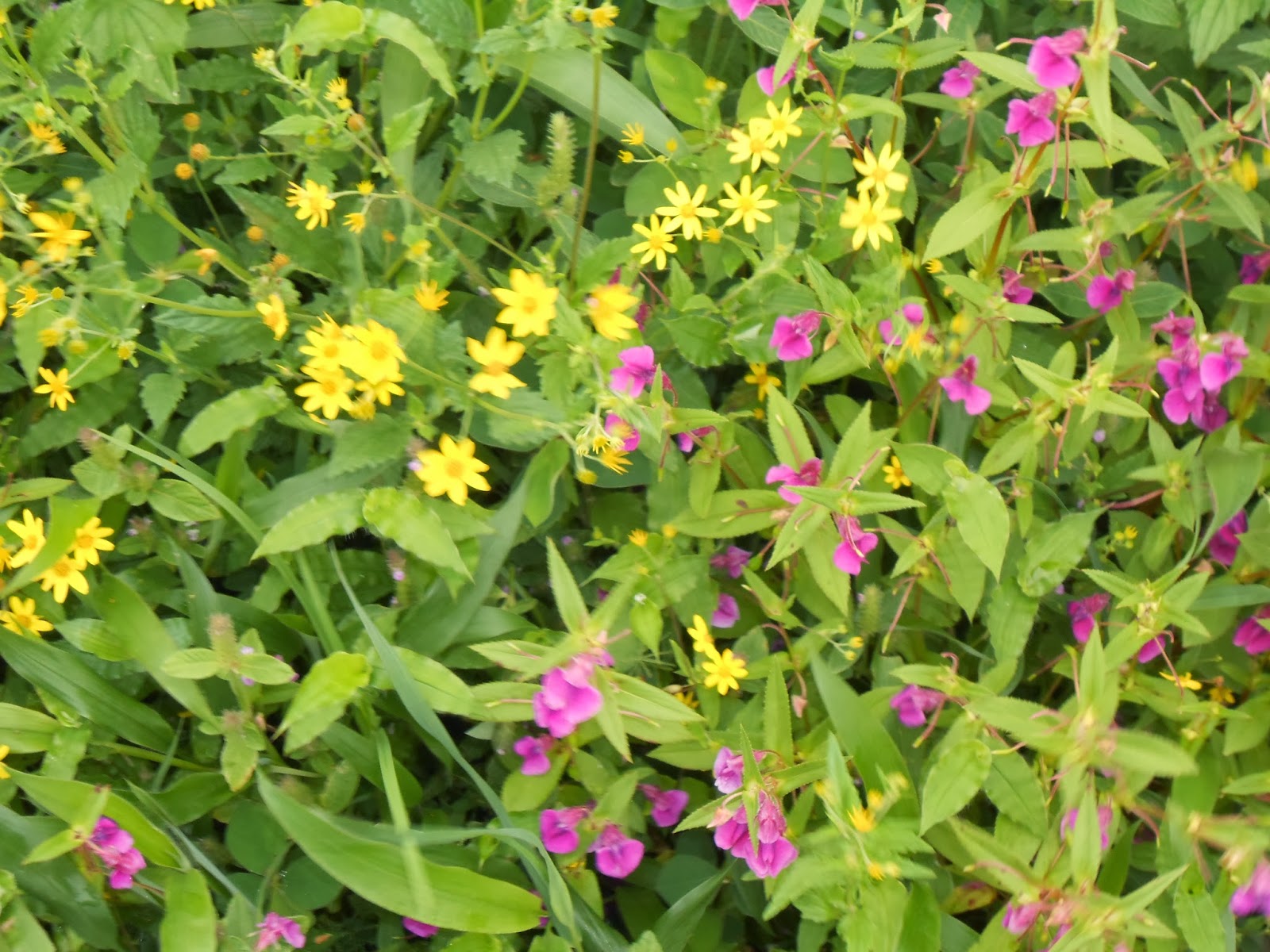
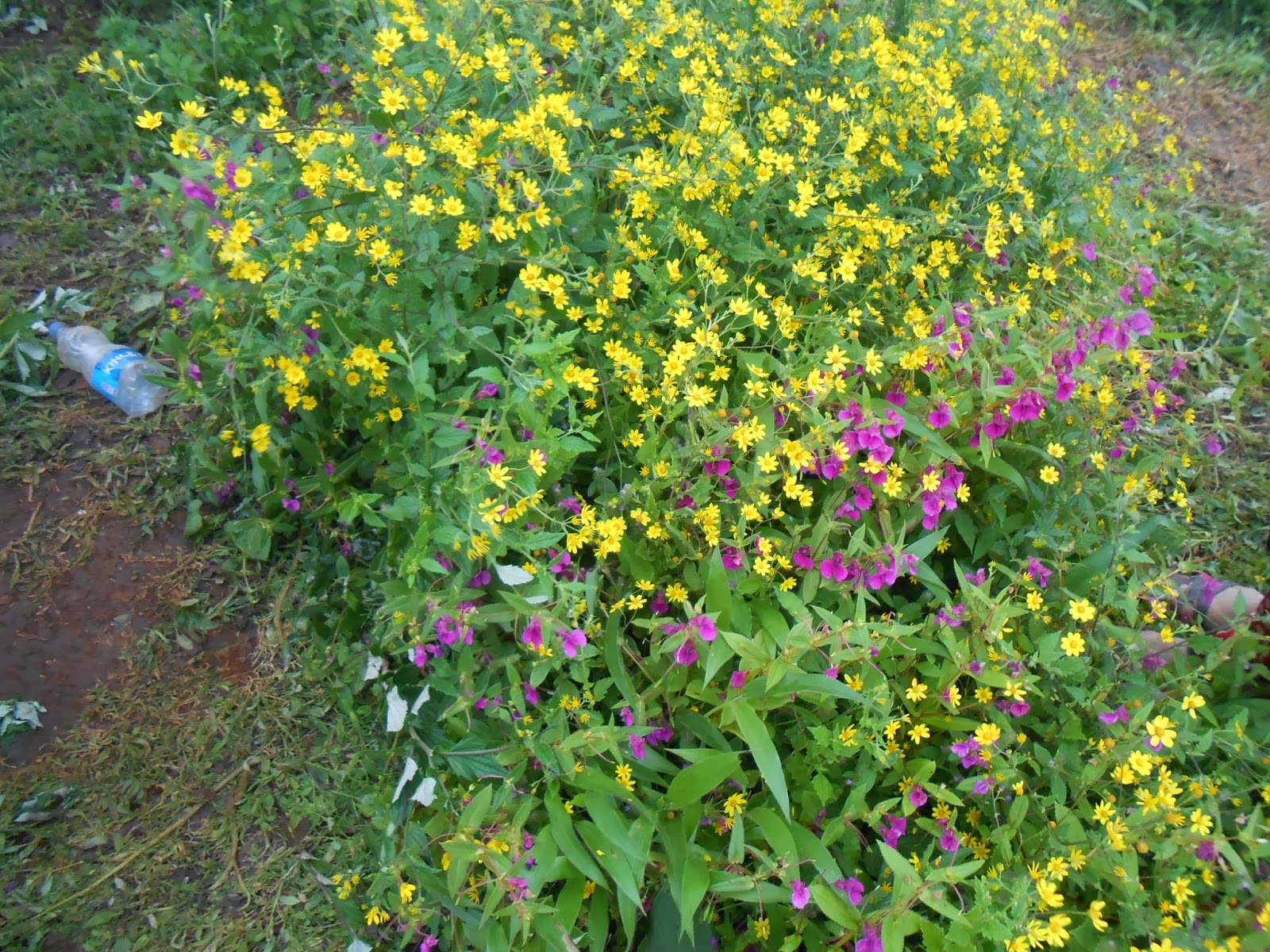
Lo & behold! Around us was a meadow awash with tiny blossoms, resplendent in myriad hues of blue, yellow, pink, purple and white! The whole field seemed like a sea of colorful waves being ruffled by the breeze. The swarm of blossoms twirled and swirled casting colorful ripples across the plateau. Yelps of glee mingled with sounds of snapshots.


Suddenly the lines of Wordsworth emerged forth the hinterland of my mind, “Ten thousand saw I at a glance, tossing their heads in a sprightly dance!”

Patches of purple interspersed with pink and speckles of white, dotted the mead. I must stress that the wind played spoil-sport blighting our efforts to capture the scene clearly.


So we waited with bated breath for the wind to abate. It was as if nature conspired to test our patience. Along with the howling wind, came the mist, shrouding the entire plateau! 

As we stood admiring, rays of sunlight trickled onto the field, lifting the veil of fog. It was as though a magic wand had stopped the ferocious wind! Again we began clicking a few snaps, when another gust of wind blew hard and long. 

And once again Mother Nature gently tucked her blossoms swaying on the flower bed in a blanket of mist!


Thanks to the vastness of the plateau that spans about 10,000 hectares, the swarm of humanity that had gathered was evenly distributed. The howling wind acted as buffers to human voices.

It was as if the sun and cloud were playing hide and seek! With hills and houses nowhere in sight and with just multitudes of wild flowers around us, it just felt magical.

Grazing cattle oblivious to the crowd that had gathered to witness the spectacle completed the picture...


By 5pm, when monsoon clouds began to loom large, the guards (shall we say the whistle blowers?), signaled us to vacate the place. Nature had her own way to indicate that time was up. Reluctantly we retraced our steps…turning our gaze backwards with every step we took forward. 


Kaas….it’s so near, yet so far…for, the valley bursts open in a riot of colors when autumn falls! So, even if we wanted to make another trip, given the proximity to Mumbai, we have to wait for another year…for it is only during Fall that the seeds of magic fall from Mother Nature’s golden pot!

Yellow Senecio Grahamii

Pogostemon Deccanesis

Pogostemon Deccanesis


How to reach Kaas-35 kms from Mahableshwar
Satara to Kaas-25kms
Mumbai-Satara-254 kms. You should reach Satara from Mumbai in 4 and a half hours time.
Best time to visit Kaas: Mid August to Mid October

Tip: Before you book your trip, check if the flowering season has begun. Book a hotel at least a week before your journey, because given the peak time, hotels will be full. There are no hotels at least 2 kms in sight, although few private cottages may agree to accommodate guests for a night.  

Caveat: Please avoid trampling on the tiny stems and flowers as you tread across. There're pathways carved out for people to amble along. Stick to this route.

Do carry light woolens and scarves, as it can turn windy. 

THOSEGHAR WATERFALLS


Kaas and Thoseghar go together. If autumn is the harbinger of the floral carpet that covers Kaas, it also marks the end of monsoon with sparse spells now and then. 

20 kms from Satara, Thoseghar undoubtedly is a crowd-puller! The retreating phase of monsoon is most alluring. With torrential rains having subsided, drizzles fall gently from the clouds above, cloaking hills and valleys in a velvety emerald. The remaining water empties from cliffs above- onto the vales below. 

The drive is something you’d die for! Snaking through bends, when you trudge uphill, the view below seems like a coiled serpent wading its way through the verdant plains. The fragrance of wet grass instantly revitalizes! 

Hues of green ranging from brownish green, olive green, yellowish green and emerald green seemed to spill forth Nature's palette, painting the tapestry in its entirety. 


With blotches of black stones dotting the different shades of green, it seems as if Nature has strewn these across to guard the scene from evil eyes!


Pretty Violet Balsam Blossoms 

Paved paths ensure an easy stride. 

The sound of cascading water breaks the tranquility. As we ascend a flight of steps, the sound seems clearer. 

And suddenly we come face to face with a surge of silver, gushing forth the green hills, forming another torrential rivulet on land! 


Tiny rivulets crisscrossing the luxuriance, is a sight to behold! 
Taking in as much as the eyes can capture, I capture more... on my lens that would perhaps serve as a memento later…

Outside is a small museum displaying the various blossoms blooming in the valley. Other significant details of Sajjanghad Fort and the nearby places are detailed too.


The verdant vales are a veritable haven in whose lap various flora and fauna thrive, occasionally peeking to witness the world of humans go by...   

Wednesday, 6 November 2013

KHAJURAHO-SENSUOUS STORIES SET ON STONE

KHAJURAHO-SENSUOUS STORIES SET ON STONE

Besotted by the splashes of marvellous monuments and cenotaphs on sites, and of course piqued by curiosity to know more about the bees and birds that hover around Khajuraho, we ultimately added Madhya Pradesh to our bucket list. 
 

January of 2004 saw us making a week’s hasty trip to this vast terrain, a little after Chattisgarh and Jharkhand tore themselves apart from their ‘mother land’!
We undertook an overnight journey by road through Mumbai, and reached Indore by morning 8. After breakfast, we were raring to go and by afternoon whizzed through to reach Ujjain’s Mahakaleshwar Temple.

Ujjain

A mere 71 kms brought us to the ancient city of Ujjaini as it was formerly known. Ujjain’s Mahakelshwar Temple is one of the Jyothirlingas and the huge temple complex with the temple pond seemed undoubtedly divine. The 4 pm rush was minimal and we had a comfortable 'darshan' without being pushed and shoved.


A mere 71 kms brought us to the ancient city of Ujjaini as it was formerly known. Ujjain’s Mahakelshwar Temple is one of the Jyothirlingas and the huge temple complex with the temple pond seemed undoubtedly divine. The 4 pm rush was minimal and we had a comfortable 'darshan' without being pushed and shoved.

If you love the rustic feel of a sleepy Indian hamlet, Ujjain is the place to go, it will never disappoint you. A stroll around the village surrounding the precincts of Mahakaleshwar, gave us rare glimpses of a quintessential village life in rural India. 

Dusty roads leading to 'kaccha' homes with the occasional bleating of goats tied to posts and villagers huddled together for warmth and for whom languor is an idyllic activity
 the picture of this village was simply perfect! I couldn't but mull over spending a few days among these uncomplicated people in an unhurried pace! 

But the allure of Khajuraho made us beat a hasty retreat, for we had a night train scheduled for Satna, the following morning. 

Ujjain’s market place was less touristy and reverberated with divine chants. Souvenirs here, were bells and 'arti' plates in brass; and during our time there, the divine ambience made us determined to glut our altar back home with the burnished statues of deities, and the paraphernalia that lend a divine feel. Palm sized tailor made outfits in bright colored satin with zari (brocades) adorned the shops and we bought a dozen! 

Gods back home at my altar definitely needed a change of attire every week, or so I thought while buying these vibrant stuff!

After a 5 hours drive from Satna, we reached Khajuraho. The condition of the roads notwithstanding, we merrily darted through the roads that were flanked by cheery yellow mustard blossoms and this scene was what kept us wonder-eyed on this wondrous journey. And when the roads gave way to 'kaccha' or broken paths, the odor of cow-dung, the fragrance of smoldering twigs, the sight of ruminating cattle tied to posts and those of women with heads wrapped in vibrant 'sarees', cheered us along. We were getting closer to our destination…the pastoral Indian setting does have a charm of its own!

We drove past the village of Khajuraho in Chttarpur district exactly at 6 pm!! Wow! And the whole scenario changed in a jiffy! For the bucolic setting that was a constant even when we blinked, the village was displaying a different scene! It wasn't exactly modern. But what greeted us were lines of souvenir shops, lending a touristy feel to the place and, white-skinned foreigners ambling along clean roads. 


Sound & Light Show

The highlight of our evening visit was the ‘sound and light show’ in the voice of THE Amitabh Bacchan! We perched ourselves swathed in shawls and sweaters, on the green lawns, waiting for the sun to go down. The atmosphere was mesmeric with the sweet fragrance of dew-drenched grass and the crispness of cool air. 

A few minutes after sun down, the baritone voice greeted us even as whispers were hushed to capture the legendary voice. The spotlight fell on various niches on the cluster of temples as the voice of ‘AB’ trailed onto narrate the chronicle of the temples. 

From illustrating the story of the Chandela Kings who built the temples, the erotic themes that found their way into the façade and the grandeur of the Khandariya Mahadev Temple, the narrative seemed simply electric! It was as if we were transported back in time….


As the voice of ‘Big B’ trailed off and the narration came to a close, the crowd dispersed unwillingly. Many remained, perhaps to catch a glimpse of the aura of bygone days….Don’t be surprised if you find tourists behaving like adolescents, ogling at the brazenly displayed manuscripts of Vatsayana! And equally amusing it is to watch newly wedded honeymooners, trying hard to shake their awkwardness (that comes with ‘Indian arranged marriages’) and eye the books with reluctance. Even wooden carts selling knickknacks have these manuscripts tucked away conspicuously!
Early next morning, we found our way to the famed temples of Khajuarho. 

Khandariya Mahadev
  

The sweeping elegance of the Khadariya Mahadev Temple especially from the sides has to be captured in a single shot to be admired! A flight of steps leads you into the sanctum, thus lending a soaring look to the temple’s architecture. 


The name Khandariya is derived from the word ‘Khandara’ or ‘cave’ to mean a crest. You’d see devotees, or shall we say tourists circumambulating the shrine, more out of curiosity rather than reverence. Lo and behold! Sculpted on the edifice, are thousands of lithe figurines in various erotic poses! Running your gaze over, you’d suddenly sight voluptuous figurines come alive, striking coquettish poses! 

The famed iconic representation of Khajuraho–a damsel with a shapely figure applying kohl, is a constant here. Enshrined within, is a mammoth stone Shivlinga with the Nandi (bull) perched outside. 


Once outside, you’d come face to face with the temple fascia, bearing well-chiseled sculptures of damsels and nymphs (Apsaras) striking graceful poses. The titillating Apsaras with their ‘come-hither' look are the teasers at the start, while the best is yet to come. 

Upon closer scrutiny, you’d find every nook and cranny on the edifice, filled with ideas of 'poses' that have run amok on some creative, sensual human mind. These are sure to leave you gasping for more! 

Little wonder why Khajuraho beckons honeymooners daring to turn naivete into expertise. The poses perhaps are the expulsion of sensuous longings unleashed by deft sculptors of yore!

The profusion of carvings needs to be seen to be believed and beheld…


Lakshmana Temple


Built by the Chandela Ruler Yashovarman, this is dedicated to Vishnu and dates back to 930-950 CE. Only second to Khadariya Mahadev, this temple’s exclusivity lies in the beauty of its ‘chariot shaped’ garba-griha (sanctum). An elevated plinth gives you a reasonable view of the emerald green well-manicured lawns. 


As with any temple in Khajuraho, Lakshmana Temple also has a cornucopia of erotica, engraved on every available niche on the facade. 

On the ceiling, are more well-chiseled men and women’s busts explicitly engaging in their ‘sport’. The aesthetic expression of promiscuity is a sure tease!

The eye-catching sculpture here is that of ‘Shalbhanjika’, who stands striking a graceful pose with her ample posterior springing from a slender waist. This fascinating bearing captures the form of a maiden in its entirety and the posture notwithstanding, her ample bosom finds a mention too-albeit in stone.


VARAHA TEMPLE


This western group temple stands tall and proud, supported by 14 pillars crowned with a pleasantly carved cupola for a shikara. The highlight is the massive monolithic statue of Varaha (boar). Lavishly carved images of Gods and Demi-Gods and the carvings of Goddess Saraswati between the mouth and the nose, make this a stunning masterpiece! It must be remembered that Varaha is one of the incarnations of Lord Vishnu.    

Vishwanatha Temple

Like any other Shiva Temple, this one has too has the Nandi(bull). This structure is embellished with maidens striking a willowy comportment. 


On the western side of the temple, stands the figure of a lissome lass holding a bunch of luscious looking fruits on one hand, and balancing a parrot on the other. On one wall, is a woman fondling a baby and on the other, is another playing the flute. The most striking statue is that of a limber nymph plucking out a thorn from her foot’s sole. 

The comely look of these damsels is sure to fan the dying embers of a nonagenarian!   

If you thought only sculptors of yore could breathe life into stone, then you aren't entirely right. True, these figurines are masterpieces, but outside in souvenir shops, you’d find a plethora of stone curios which are a replica of the masterpiece adorning the temple edifice. Some of these have found their way into my home. 


Chuansath Yogine Temple

Named after the Chausanth(64) Yoginis who are the incarnations of the Goddess, this famed temple belongs to the western group. Sadly, nothing much seems to be left now of this temple. But the allure of the temple exteriors is worth a glimpse. 


Matangeshwara Temple

This Shiva Temple houses a colossal Linga and daily worship is organized every dawn and dusk.


EASTERN GROUP

This is an assortment of Hindu and Jain Temples. Among the Hindu shrines are the Barhma, Vamana and Javeri and among the Jain shrines are Ghantai, Adinatha and Parswanatha.

The Javeri Temple displays a stunning Makara Torana.


The Vamana Temple exhibits a plethora of well-chiseled nymphs aesthetically showcasing their supple forms.

The Adinatha Temple’s Shikara is the quintessence of North Indian Temple architecture and the Parswanatha Shrine is the largest. 

The effigies seem as though drawing out the feminine form in her different moods! If there’s a spry girl writing a letter, then there’s another
 sprightly  one, playing with a baby. If there’s a nimble form extracting a thorn from her foot, then another coquettish maiden waits with a garland! 


Yet another is a statue of a buxom belle tying anklets.


Chaturbhuj Temple


As the name goes, the four-armed (chaturbhuj) massively carved image of Vishnu is enshrined. The most conspicuous figurine here is that of a ‘lion-headed’ sprite. Among other depictions are mundane worldly activities of chariot-drawn carts, elephants, snakes and even scorpions! Others include the overflowing boughs of trees and pretty blossoms. This is one temple that is bereft of any erotica!  
A ‘mithuna’ couple in passionate embrace graces another wall, along with other erotica that has been brought alive in stone.

What sets these temples apart?


What sets these temples apart?

What ‘is’ the purpose behind such erotica we know not. There’s nothing parochial or prudish about these depictions; in fact these stone sculptures throb, celebrating life and its vicissitudes. Honestly, visitors to Khajuraho Temples are mainly tourists who’d go with the sole purpose of sating their curiosity. So, petitions and prayers are a far cry here. But, the statues pulsating with life have the potential to bring out the best in humans! These elegant figurines bespeak of grace, style and ardor
the very essence of humans. And I’m sure the differences between man and woman begin to fade out, as energies merge together to create the subtleties of this cosmos…erasing chauvinism and replacing it with oneness!